
Call yourself apprentice?

Backup:

Around the start of the 80s I wrote some dialogue and monologues and most of the original music for the ‘Nice (if you can get it)’ revue, directed by Margaret Ford. At the time it was put together and (briefly) toured, I was working by day for a company that built staircases (mostly). This song is based on my personal experience of working in the woodworking industry, though I was a wood machinist, not a carpenter.

In a recent conversation, I expressed some regret that I never got to do something like the radio ballads put together by Ewan MacColl, Peggy Seeger, Charles Parker et al, then realized that the revue was actually quite near to that concept.

Ian Campbell also wrote some songs in that idiom, including one called The Apprentice’s Song, but it’s about gas fitters. Mine is about an apprentice carpenter, and I’ve changed the title to avoid confusion with Ian’s song.

Originally a poem of sorts, but re-recorded as a song after a discussion about that harsh little joke in the third verse. I honestly can’t remember if it was used in the revue – it was written around that time, but maybe not soon enough to be included. Like ‘Long Stand‘, it touches on the uneasy relationship between the old hand and the apprentice – while hazing or snipe-hunting is a particularly unpleasant way of keeping the young ‘uns in their place, it’s not always considered the duty of the master to encourage the apprentice.

The tune is now mostly associated with ‘Tramps and Hawkers’, a song that seems to have been written by ‘Besom Jimmy’ in the late 19th century, though the tune is far older than that. (Ewan MacColl used the same tune for England’s Motorways, from the radio ballad ‘Song of a Road’, about the people who built the M1.)

Fetch the rolls: make the tea: then grab the end of that
And sand it till your fingers bleed, if you think you’ve planed it flat.
Call yourself apprentice? Lad, I’d be ashamed
If I knew so little, to be called by such a name

Never mind the splinters: In a year or two
You’ll have quite forgotten that they ever bothered you.
Hands as hard as English oak, muscle, skill and guile:
That’s what makes a craftsman; but not you, for a while

Cut yourself, you silly sod? Take care, if you please,
And don’t bleed on the timber: do you think it grows on trees?
Call yourself a craftsman? No, lad, never you.
Though if you try your hardest, one day you might scrape through

So you’ve got your piece of paper? I hope I’ve taught you well,
And I won’t deny you’re willing: no doubt time will tell.
Call yourself a craftsman? That’s as may well be…
Another year, or five, or ten, and then perhaps we’ll see…

David Harley
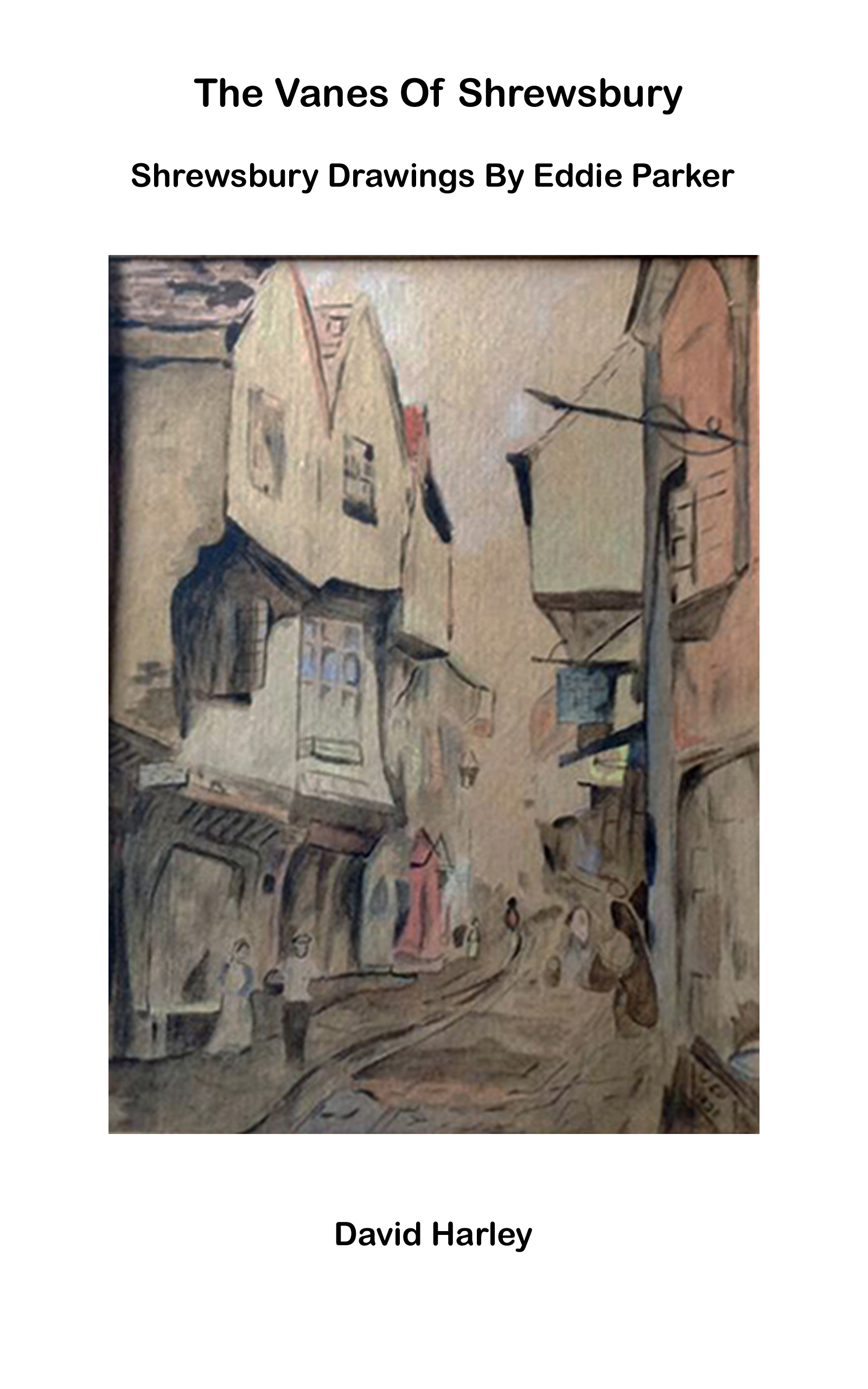
The Vanes of Shrewsbury – book

For some months, now, I’ve been working on a book that takes my album ‘Tears Of Morning’ as its starting point. Tears Of Morning is a collection of songs and settings (plus a couple of instrumentals) that have a sometimes tenuous connection with Shropshire. The book will include most of the music and all the lyrics, but with a shedload of additional historical, literary and anecdotal material. It will also include some songs and verse that didn’t make it to the album.

That’s still in progress, and should be available fairly soon, in fact. However, I got (pleasantly) sidetracked.

Originally, I planned to include some drawings by my late uncle, Eddie Parker, who, although he spent his retirement years in Australia, still had a keen interest in Shropshire history and architecture. The drawings were to be published with appropriate commentary and, where possible, contemporary-ish photographs of the same buildings. However, it soon became obvious that I had way too much material to be shoehorned into an appendix, and it deserved a book of its own.

That book is the small but perfectly-formed (I wish!) The Vanes Of Shrewsbury (a title taken from A.E. Housman (A Shropshire Lad XXVIII ‘The Welsh Marches’).

High the vanes of Shrewsbury gleam
Islanded in Severn stream

 While the drawings all show buildings in Shrewsbury, the subject matter extends much further: for example, to the collapse of Old St. Chad’s in the 18th Century, the legend of the Dun Cow, how the Dana walkway is connected to the book Two Years Before The Mast as well as my time working with the security firm ESET, Sir John Falstaff and the Battle of Shrewsbury, and the evolution of the Fire Service. It also includes a preview of the book I’m working on now!

It’s available from Amazon in three versions in order of ascending cost:

Cover illustration of 'The Vanes Of Shrewsbury'
Cover illustration of ‘The Vanes Of Shrewsbury’

Jack in the Box revisited

…now with added music. (I suddenly noticed that it fitted a traditional tune perfectly!)

It also fits the subject matter of a book I’m working on: more on that in due course…

local backup:

Down in the workhouse when I was a lad
No tongue can relate all the pleasures we had
Dry bread, and Bastille soup by the bowl
And a flogging or two for the good of our souls x2

A tale I recall of those happy times
And an orphan lad always to mischief inclined
He was ever in line for a kick, at the best
And the poor workhouse master could scarcely find rest

Till came the day one of the other lads died
“Aha!” says the master, “I’ll settle your pride!”
He shut up the lad in the dead-house to stay
Alone with the coffin until the next day

But what should Jack do but open the box
He takes out the corpse, and with it swaps clothes
Props it up on the rail at the top of the stairs
Then he hops in the box and the winding-sheet wears

And when it grew dark, the master came up
With a plate for Jack, some victuals to sup
Holds it out to the corpse on the rail
Who says not a word, but stands stiff, cold and pale

“Well, take it!” the master says in surprise
“I should think you’d be starving by now, damn your eyes!”
Then up leaps Jack, who was lying so still
And says “If he wunna eat it, I will!”

When the master heard this he got such a fright
He let go of the plate, and turned whiter than white
Gave a terrible shriek, such a fright did he get
Fell back down the stairs and near broke his neck

Wasn’t that a sad fall for a man such as he
So kind to his charges, with his boot so free?
So pity the poor who must live on the Roll
And think on the guardians and pray for their souls

A half-written song of mine based on a story of Knighton workhouse from ‘An idler on the Shropshire borders’, by Ida Gandy. Told to her by Ellen Hughes (nee Jordan) 1864-1940 also known as Granny Hughes. Many thanks to her great-granddaughter Denise Lewis of the Memories of Shropshire FB group for the information and photograph.

The tune is the well-known ‘Down-derry-down’ tune used for  various nautical songs including ‘The Dreadnought’/’Flash Packet’/’Liverpool Packet’/’Flash Frigate’… Though I guess it’s more naughty than nautical.

I don’t have much information about Knighton workhouse but some workhouses had their own burial grounds.

(c) David Harley